 Follow @EversimGames


UPGRADE VERSION
Geo-Political Simulator – 2027 Edition
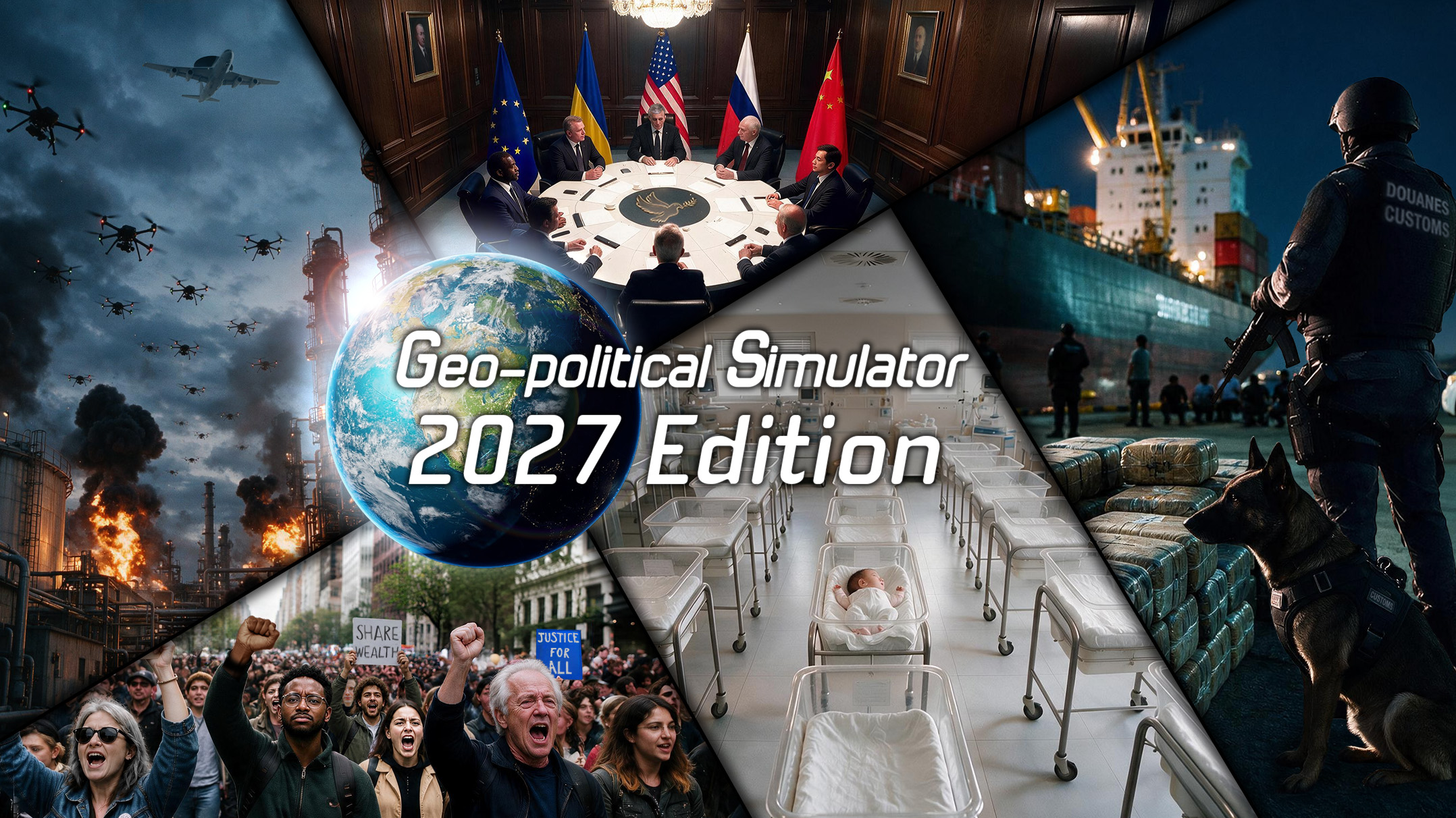
New edition of the hyper-realistic world simulator: lead a country as head of state or take charge of the opposition! New: drug trafficking, peace conferences, expert dashboards on purchasing power, growth, employment and demographics, plus global education rankings.
Choose the format:


2027 EDITION NEW FEATURES
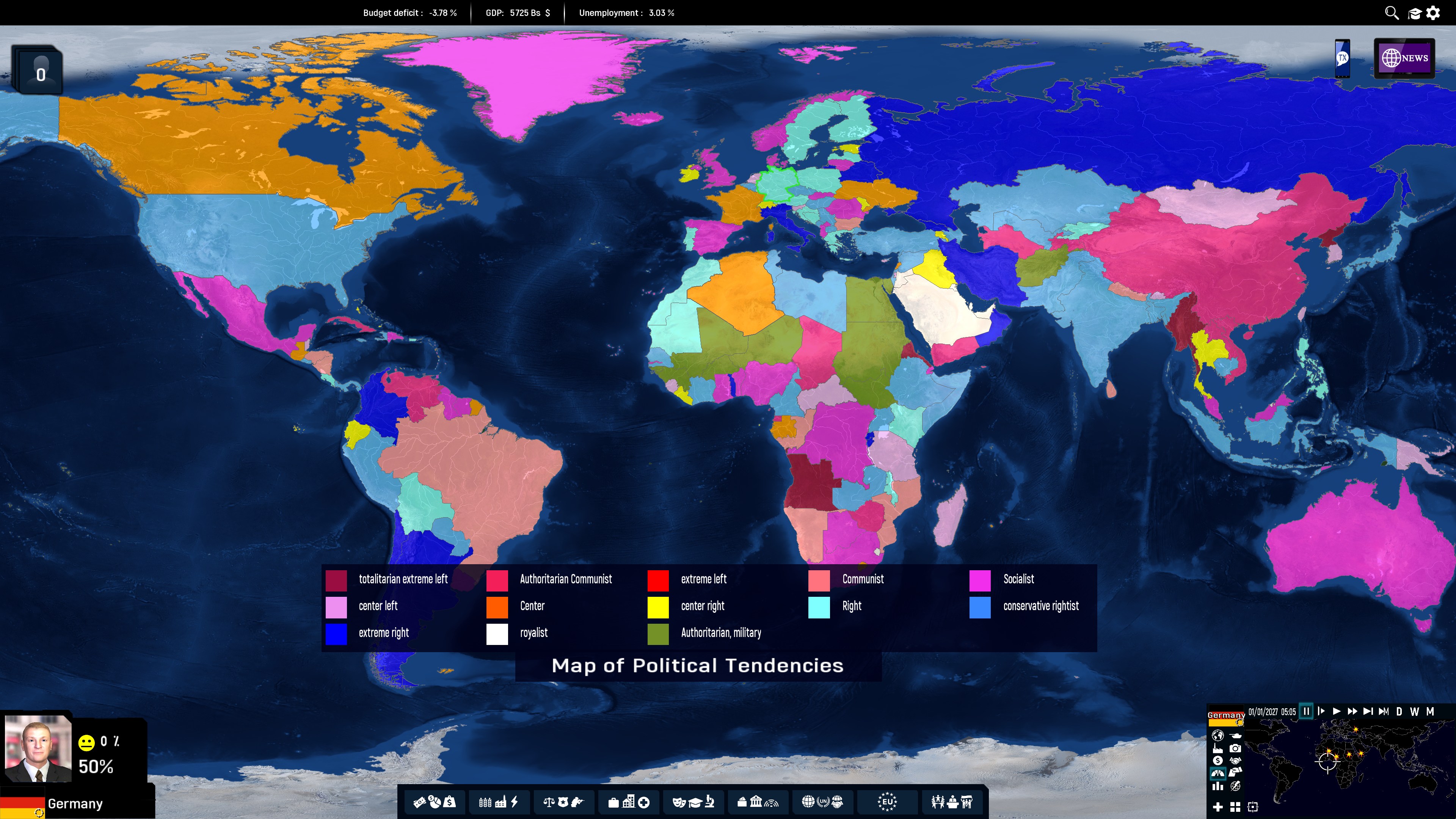
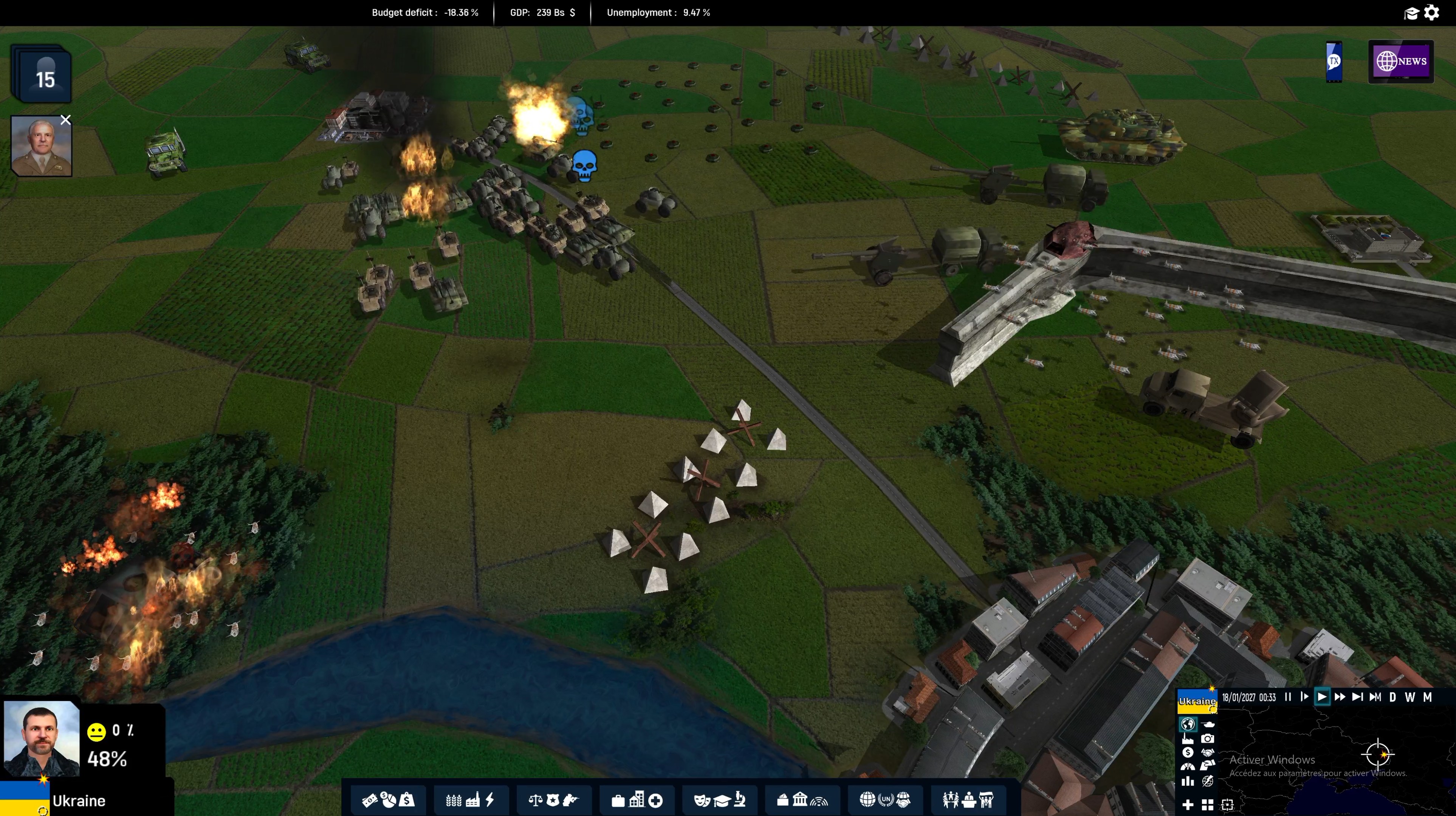
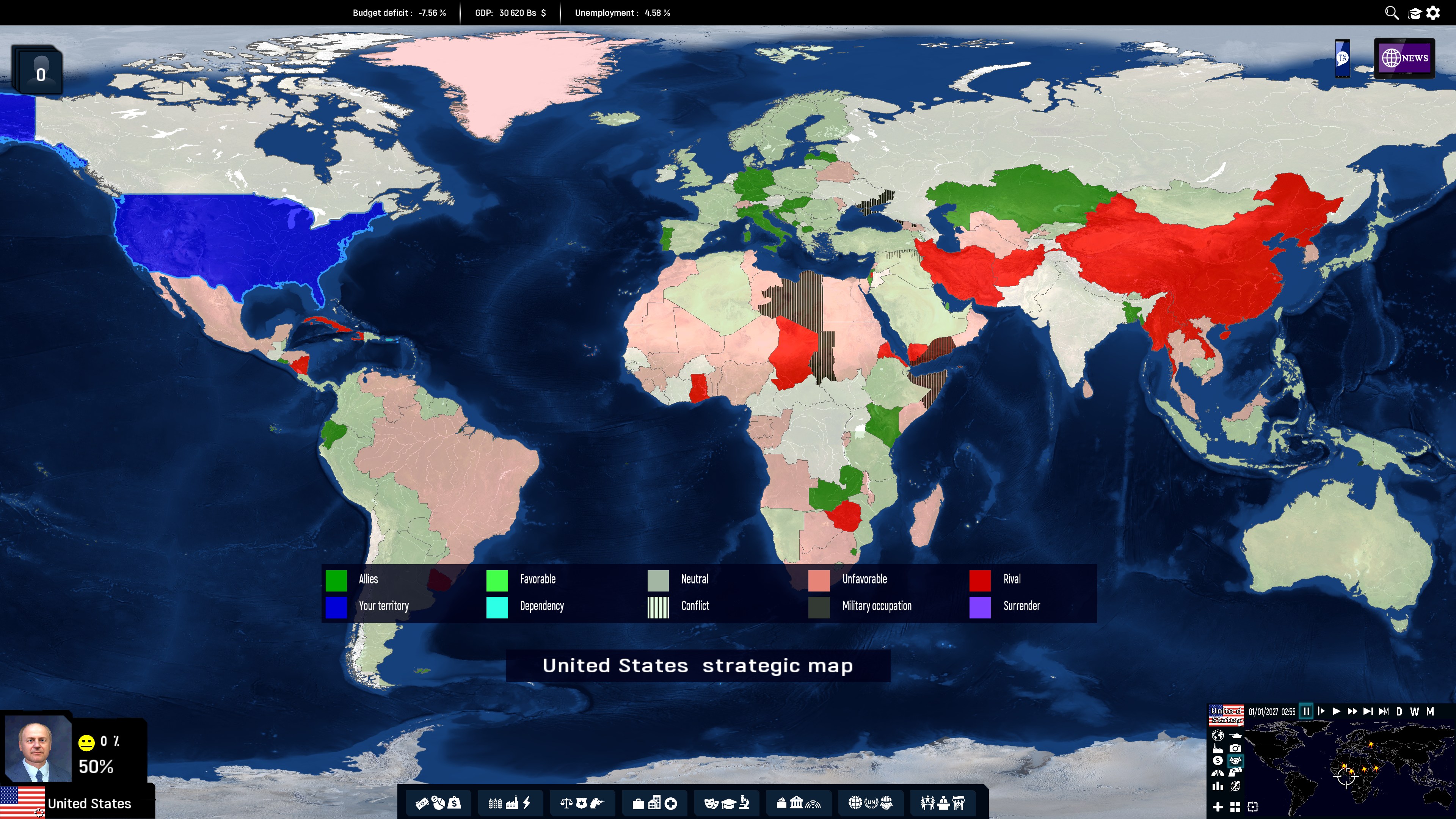
- 2027, tipping into the unknown?
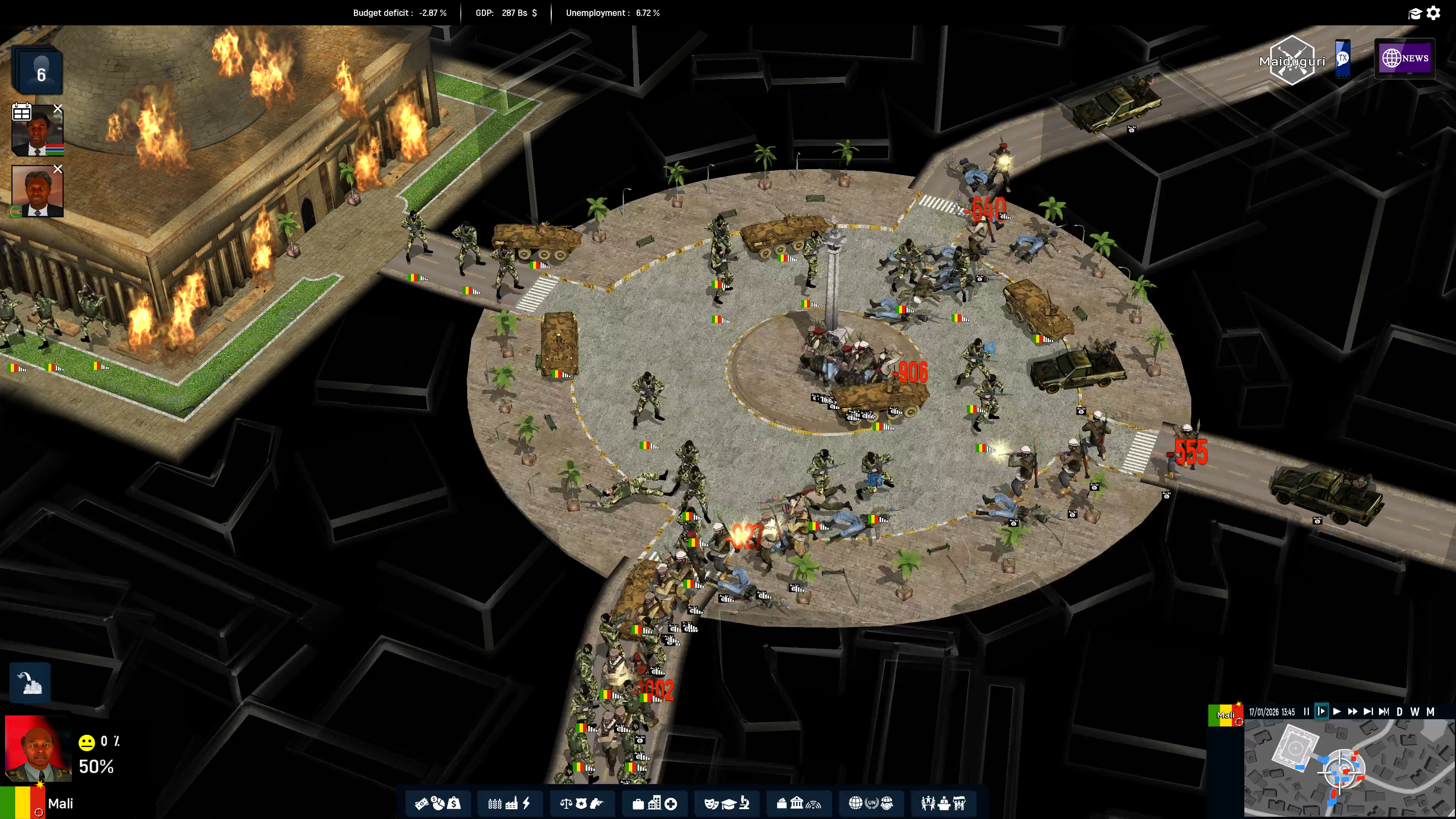
Is the world on the brink of implosion? Literally and figuratively, dark clouds are gathering over the Blue Planet. The effects of global warming are no longer just numbers on a chart but violent weather events affecting every region of the world. On top of this come the persistent conflicts in Ukraine and the Middle East, with no apparent path to resolution, whose impact on global energy costs affects people’s daily lives. In this destabilized world, criminal organizations exploit weaknesses in society to expand, supplying drugs to populations under pressure. Across the globe, anxiety is growing, and populist movements capitalize on it to challenge the established order. The Western world is beset by uncertainty and faces a host of challenges: high debt levels, industrial decline, demographic downturn, and migration management. Its system is being called into question, especially in Europe, where three major elections will take place in 2027—in France, Italy, and Spain—that will redraw the balance of power on the Old Continent. In this rapidly changing world, can a visionary and determined leader alter the course of events? - Fight Against Drug Trafficking
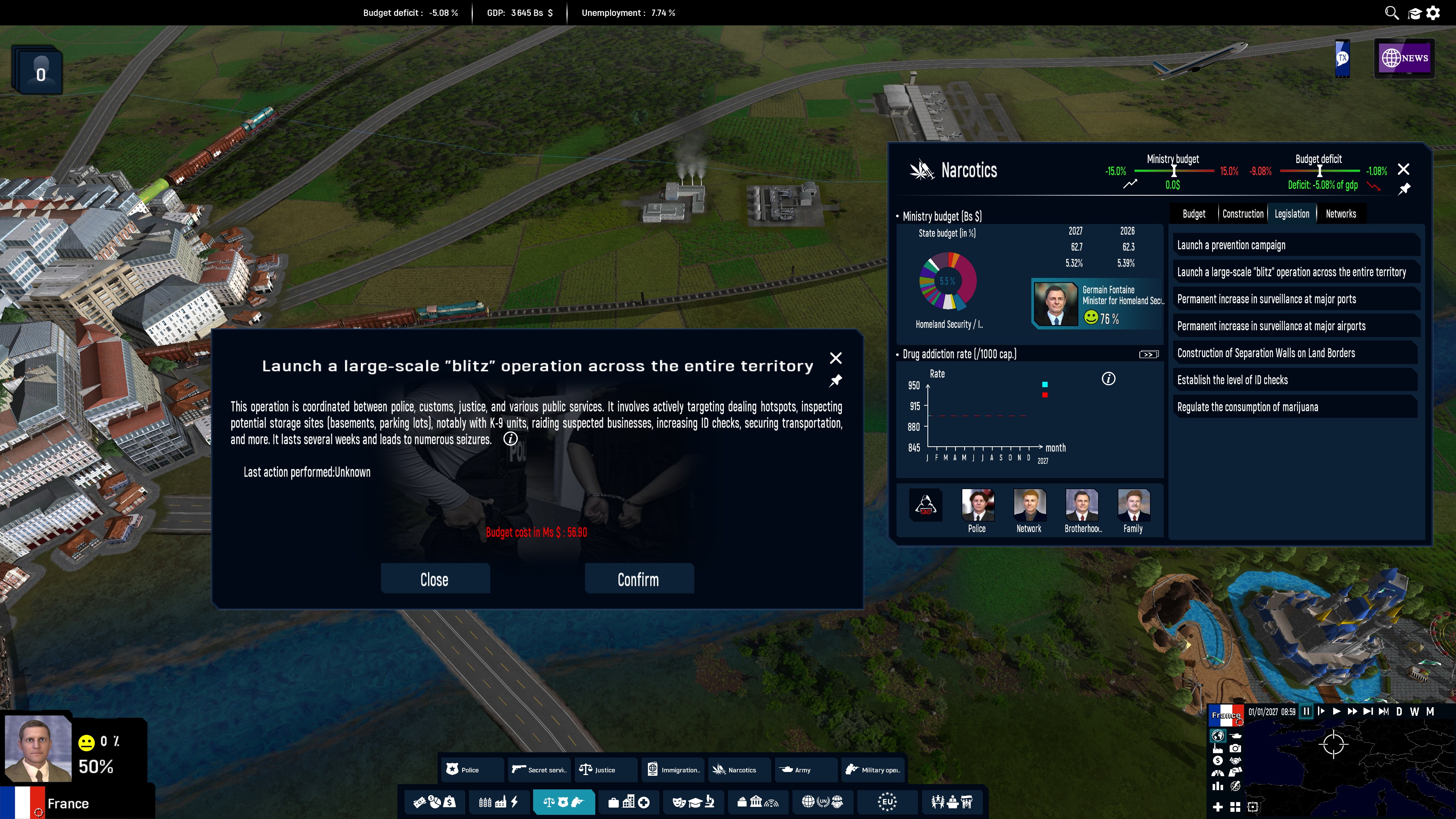
Introduction of a drug trafficking simulation based on up-to-date data on production and consumption by country for different types of drugs, the routes and volumes of international flows, trafficking networks operating in each country, and the main entry points used by traffickers.
The player has a wide range of tools to combat drug trafficking and its consequences. On the budgetary front, they can increase funding for specialized law-enforcement services (anti-crime units, customs and border services, and anti-money-laundering units) as well as addiction treatment services. They can build high-security prisons to isolate drug lords or construct border barriers along major trafficking routes. The player can also launch prevention campaigns to reduce drug addiction, legislate on identity checks or cannabis use, or strengthen surveillance at airports and seaports. Some seizures will generate revenue for the state. Finally, players can wage a full-scale war on cartels through nationwide crackdowns, infiltration operations, informant recruitment, the interception of suspicious vessels, attempts to dismantle criminal networks, extradition requests for gang leaders, and raids on cartel headquarters abroad in cooperation with intelligence services.
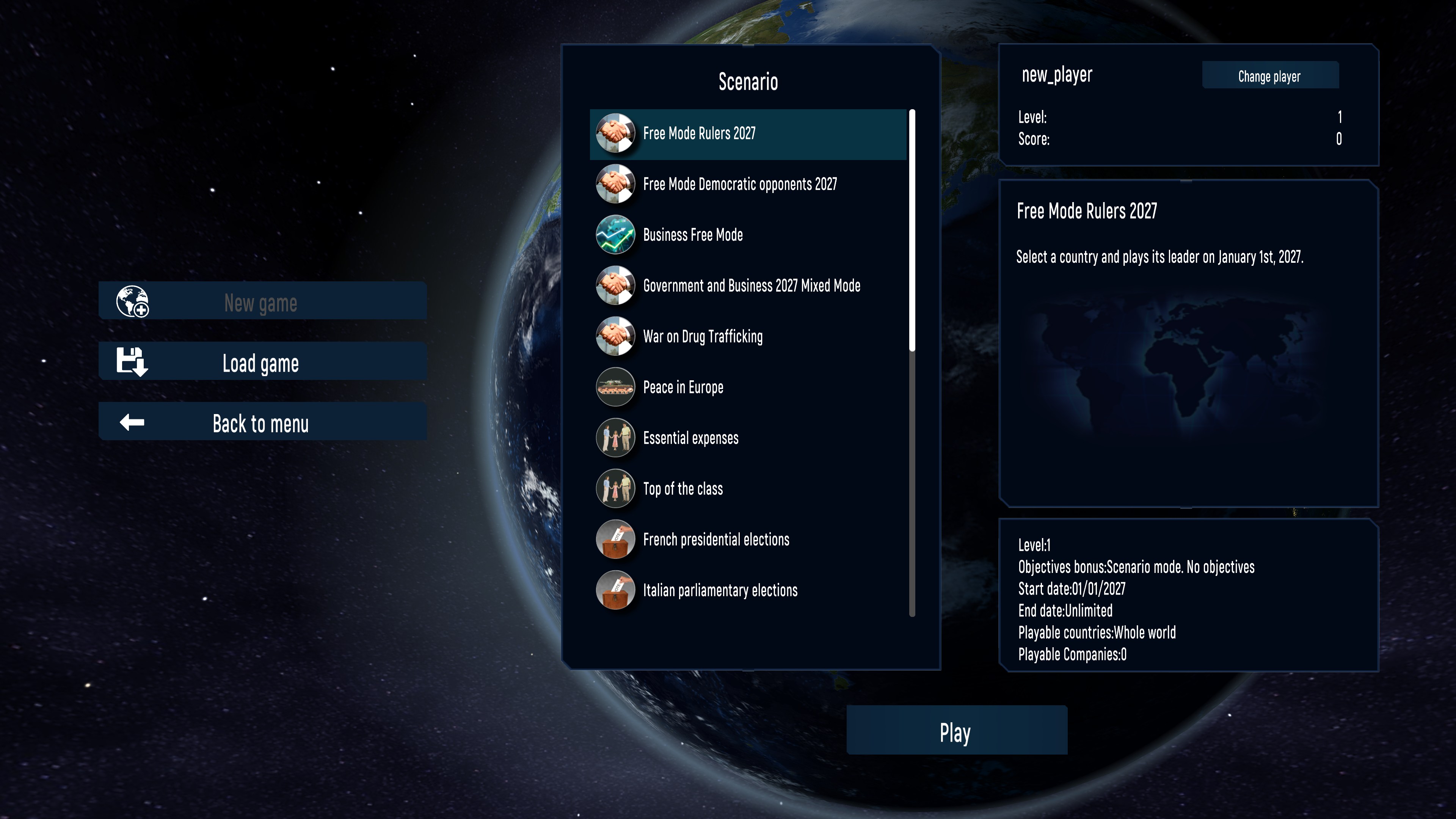
A new scenario, “War on Drug Trafficking,” provides context for the topic. - Peace Conference
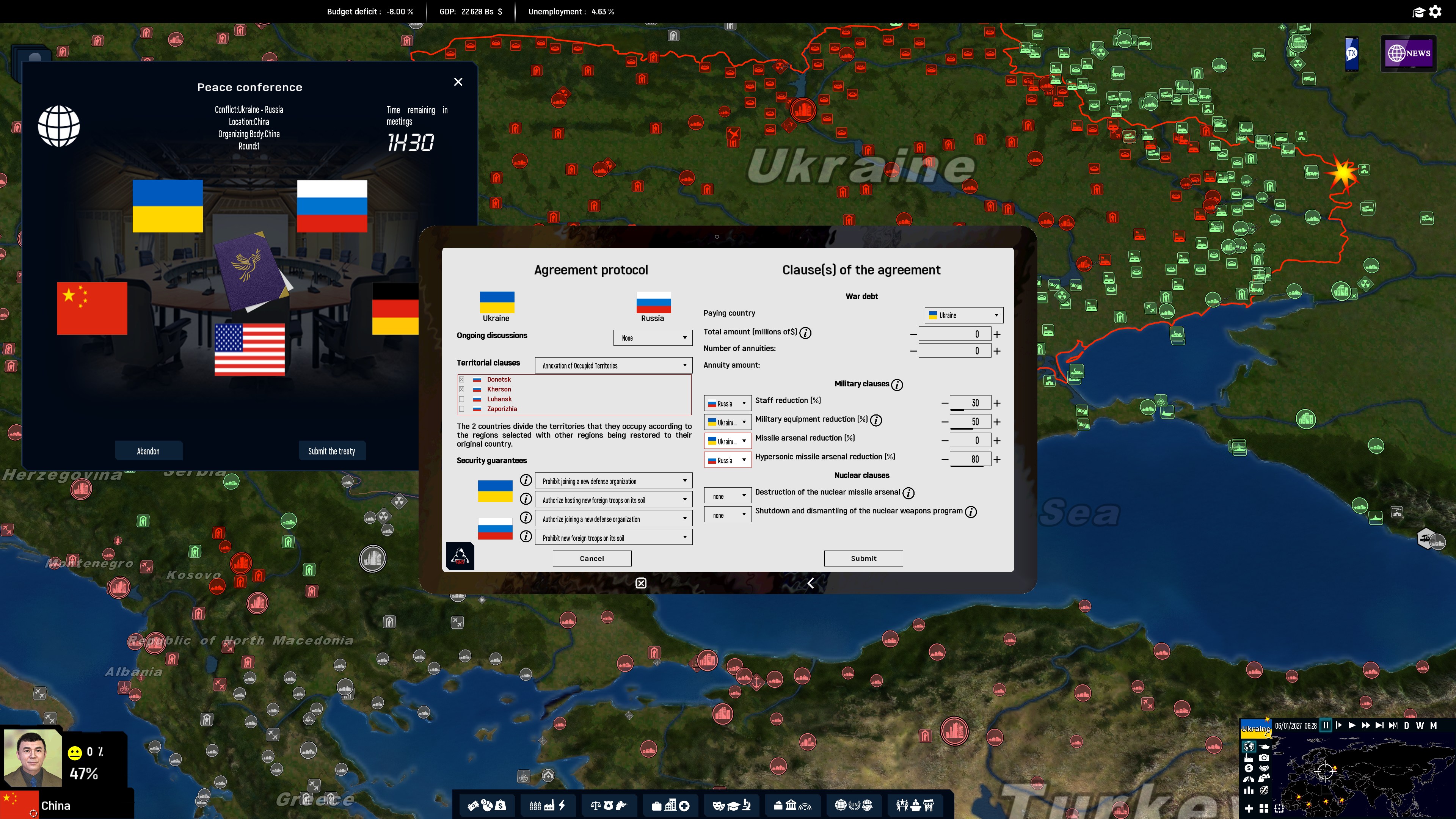
Whether leading a country at war or at peace, the player can organize major peace conferences to broker a ceasefire and negotiate a lasting peace agreement.
Successfully carrying out this delicate operation requires diplomacy and strategy. In addition to the belligerents, the host can invite other countries to the conference, allowing them to exert diplomatic influence on the warring parties. During negotiations, the player can present each party with a draft treaty and adjust a wide range of terms: territorial settlements, war debt, limits on military arsenals, missile stockpiles or troop levels, the termination of a nuclear weapons development program, destruction of nuclear stockpiles, and security guarantees (such as the permanent stationing of foreign troops on one party’s territory or membership in an international defense organization...). The conference can take place over several rounds. A truce is observed throughout this period. Once a peace agreement has been signed, its terms are monitored over the long term; if they are not respected, the conflict may resume.
The “Peace in Europe” scenario lets the player take on the role of the leader of a major world power and attempt to end the conflict between Russia and Ukraine by bringing the belligerents, and potentially other nations, to the negotiating table. - Geostrategic Conflict Report
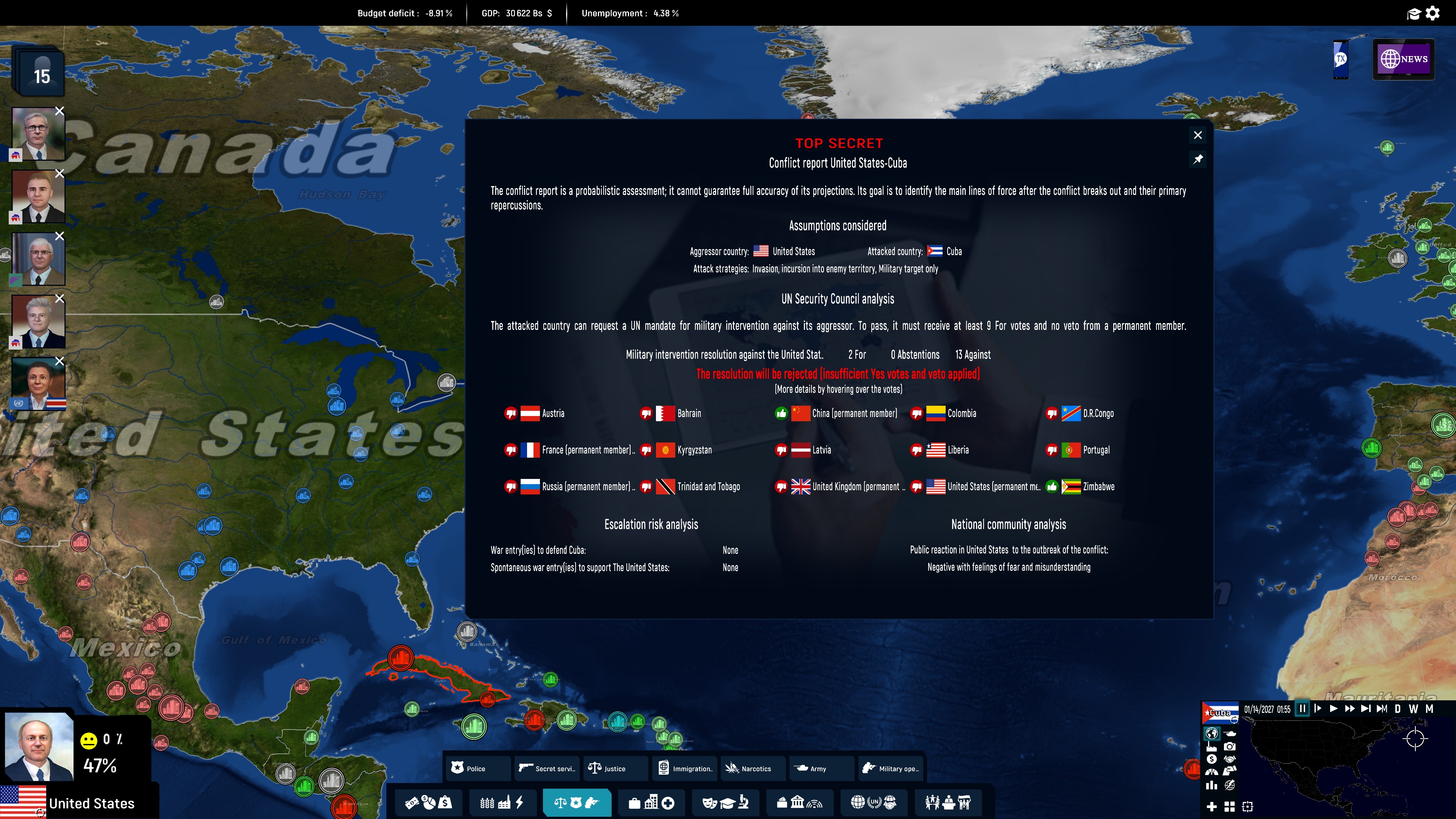
The player–head of state can now commission a strategic report to assess how domestic public opinion and the international community would react to the outbreak of any conflict. In addition to selecting the protagonists, the player can configure a hypothetical conflict by defining the attack strategy (bombing, invasion, military targets only, etc.)
Based on analyses by defense services, intelligence agencies, and the diplomatic corps, the report’s conclusions provide insight into the feasibility and consequences of going to war, particularly for players pursuing expansionist strategies. The “Bellicism” game setting can also be used to adjust gameplay scenarios. - Pro-natalist measures and demographic simulation
Various measures are added to boost birth rates. A birth grant can be set and paid at the time of birth. Maternity and paternity leave allow the player to set the statutory duration of paid leave. Finally, the construction of public daycare centers helps support families with childcare for their young children. All these measures are initialized at the start of the game for each nation.
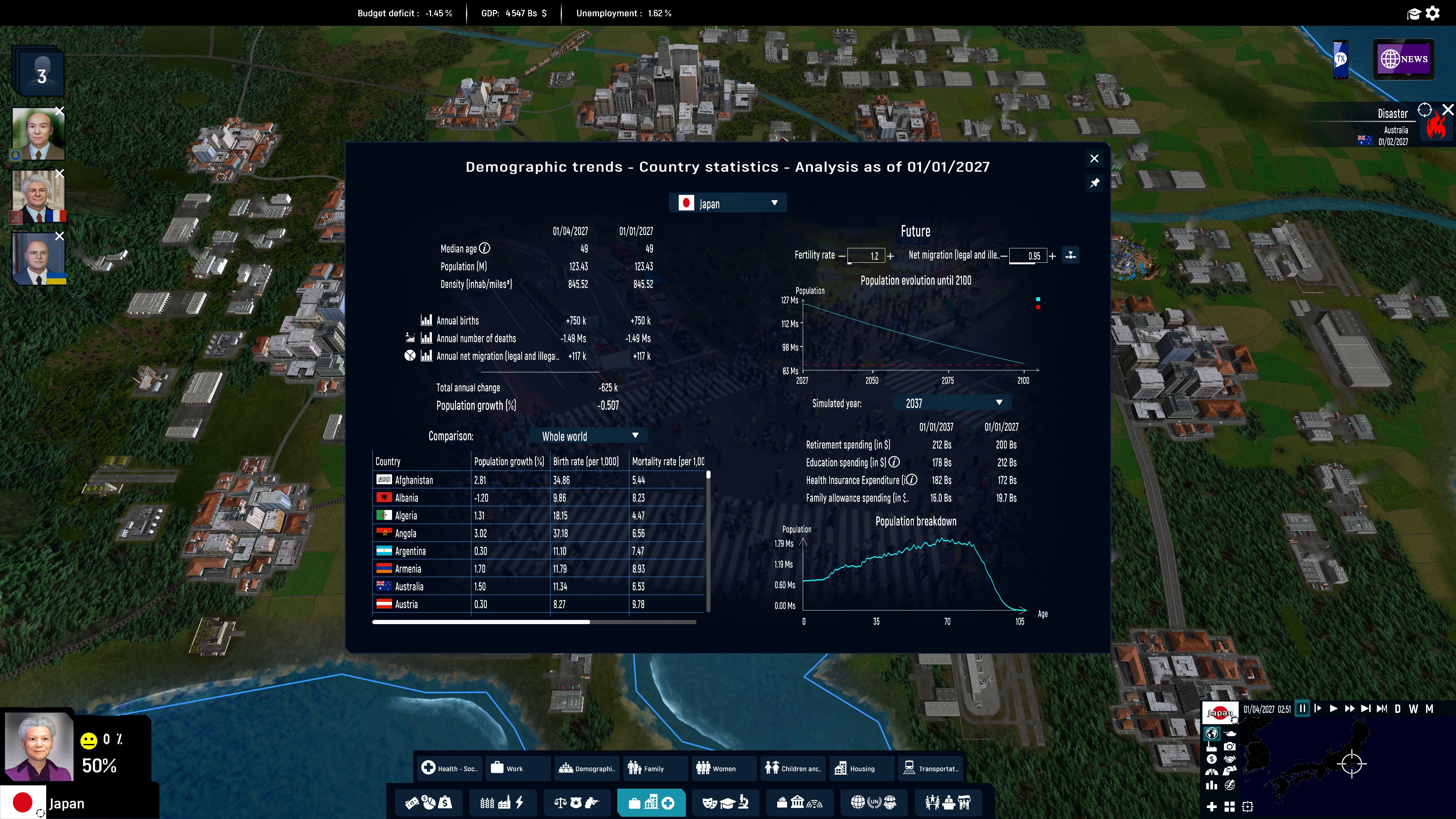
A large analysis panel on demographic trends, for any country in the world, visualizes the different variables related to this topic, including median age, annual number of births, annual number of deaths, and net migration. Adjustment tools allow the player to compare values directly between countries and project future population trends by changing the fertility rate or net migration. Also displayed, for any given year, are projections of public spending on pensions, education, health insurance, or family allowances. - Dashboards for purchasing power, employment, and growth
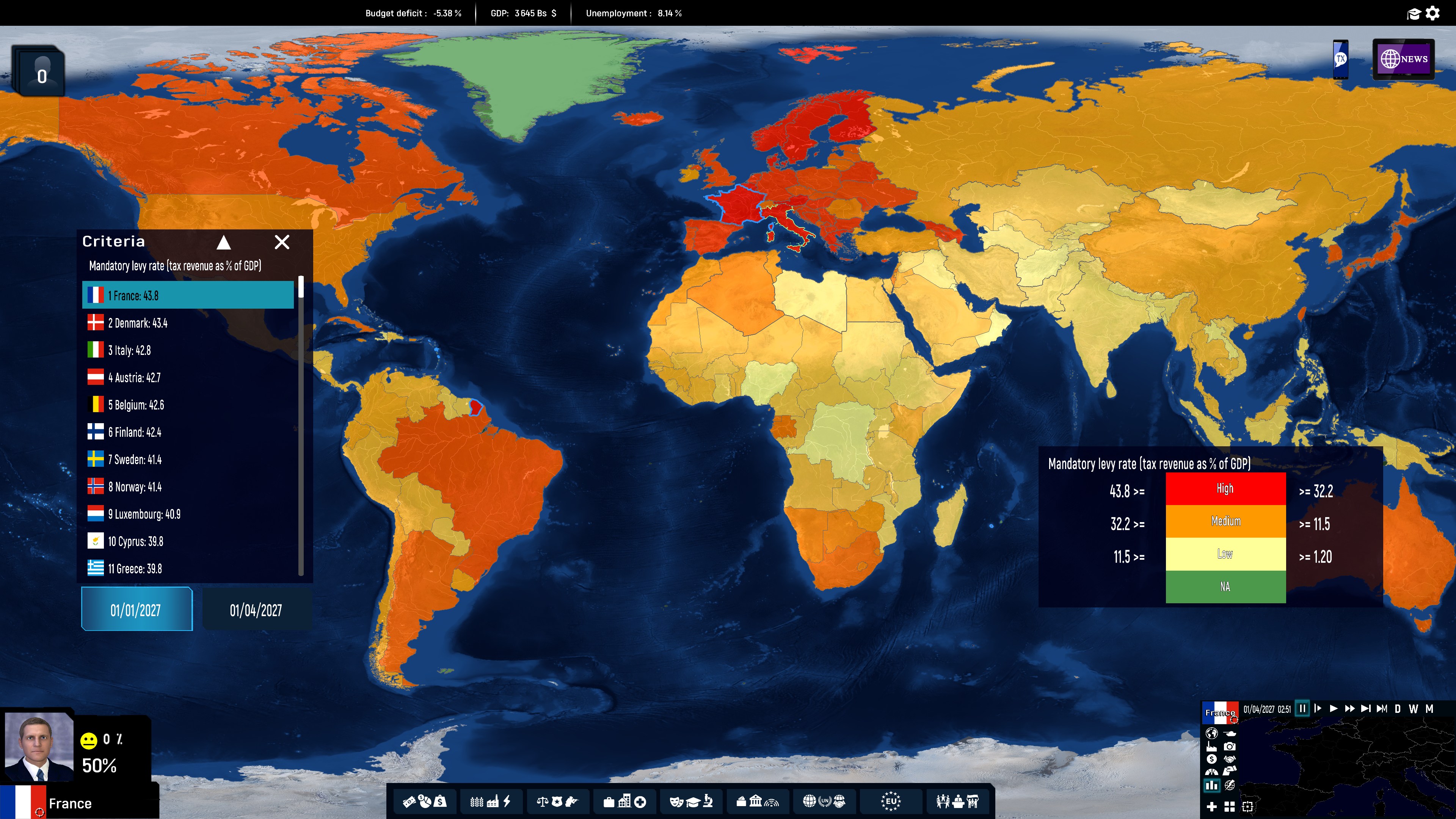
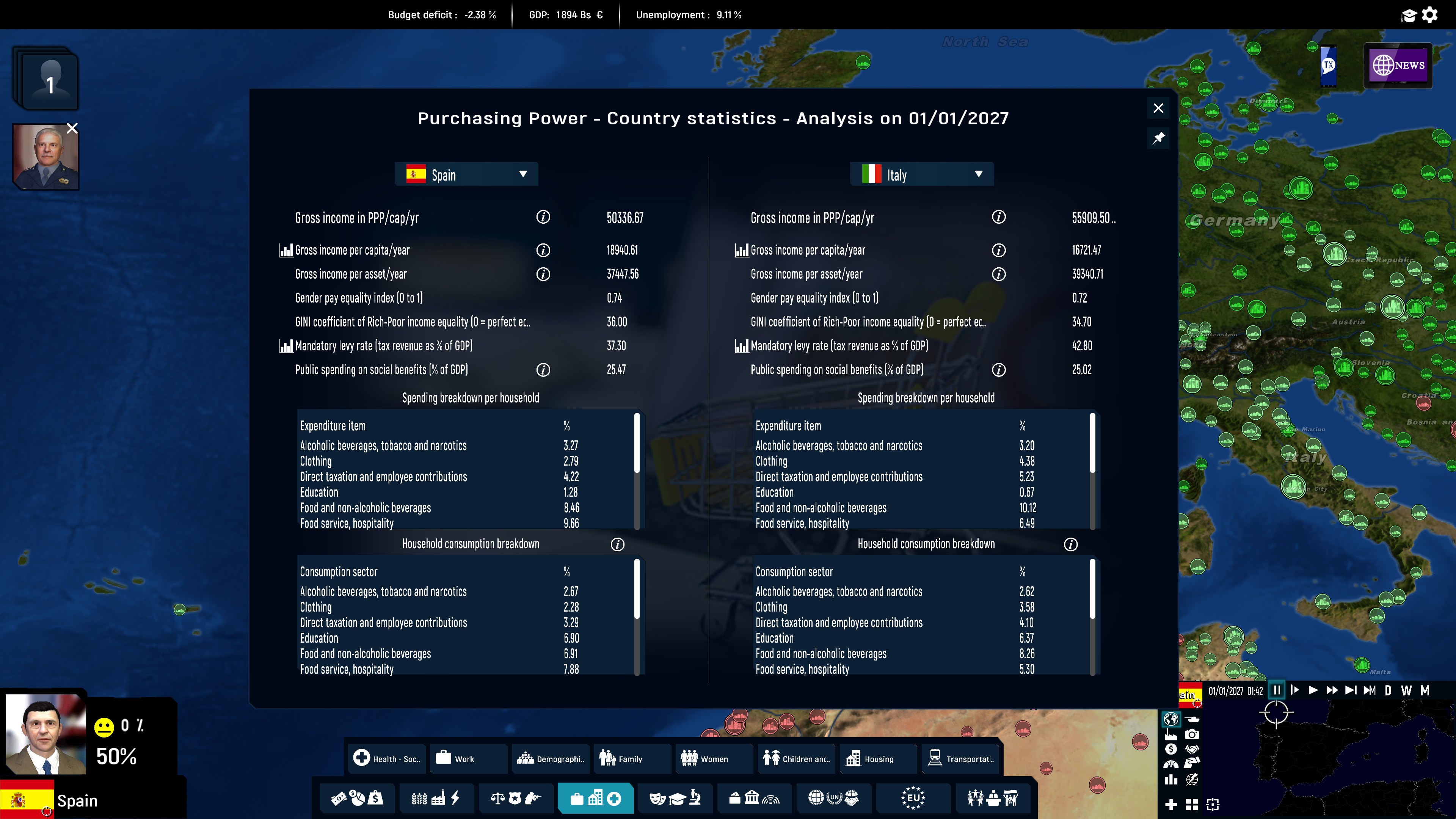
The purchasing power simulation has been enhanced with new household data for every country, making it more accurate. It now takes into account the savings rate, the overall tax and social contribution rate, income levels including minimum-income benefits and other allowances, detailed consumption baskets, and the level of public coverage for household spending on health, education, housing, transportation (including the extent of fare-free public transport), leisure, and culture. A summary screen lets the player track changes in purchasing power and compare countries directly. The themed scenario “Essential Expenditures” challenges players to drastically reduce, in developing countries, the share of household budgets devoted to food, health, and housing, with the goal of bringing it below the 50% threshold.
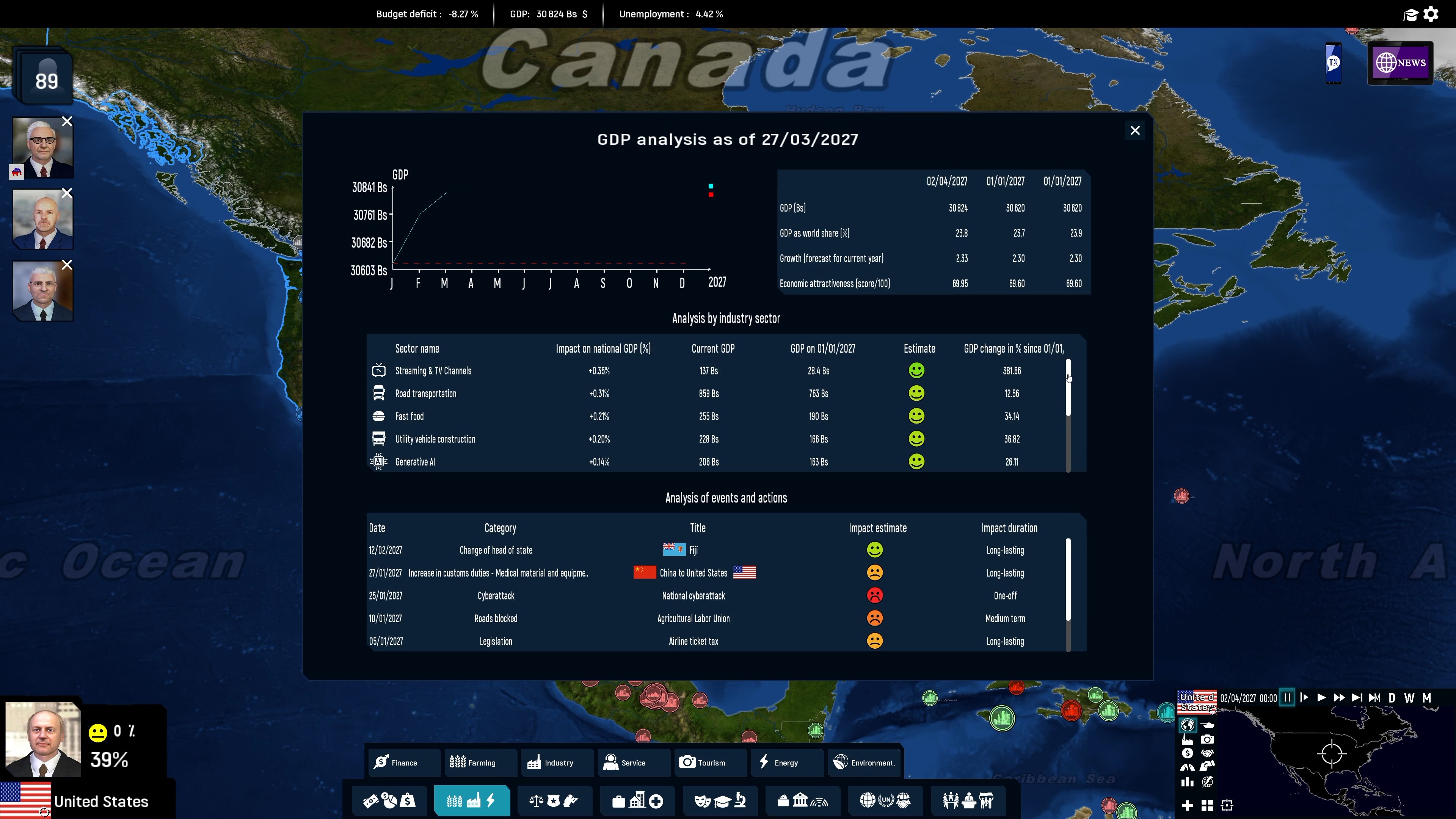
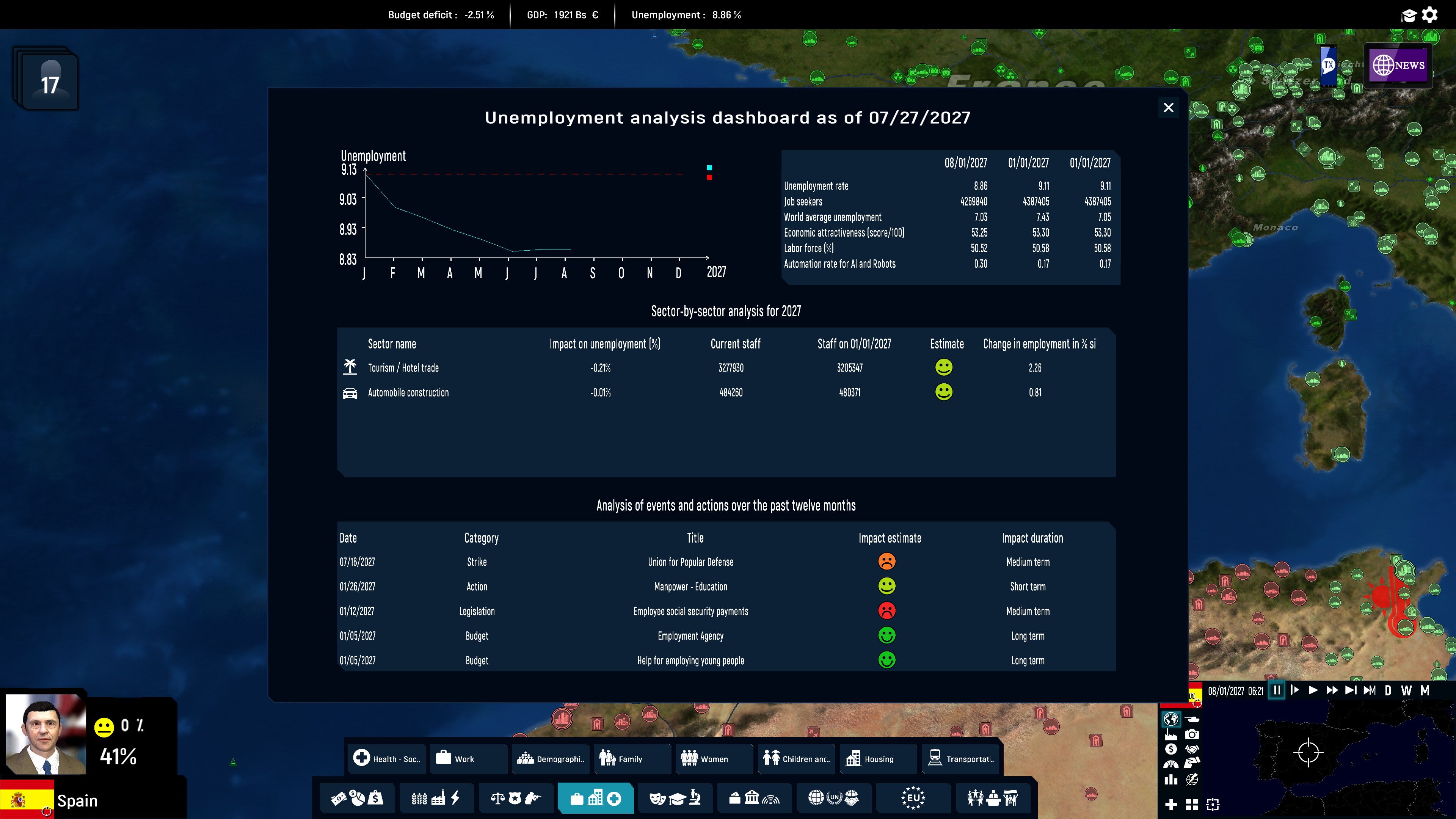
Additional dashboards provide clearer real-time tracking of employment and economic growth, two key national indicators. They bring together a time series chart, key variables, a list of sectors of activity, policy actions, and the events (war, natural disasters, unrest…) that have the greatest impact on these trends. - International rankings in education
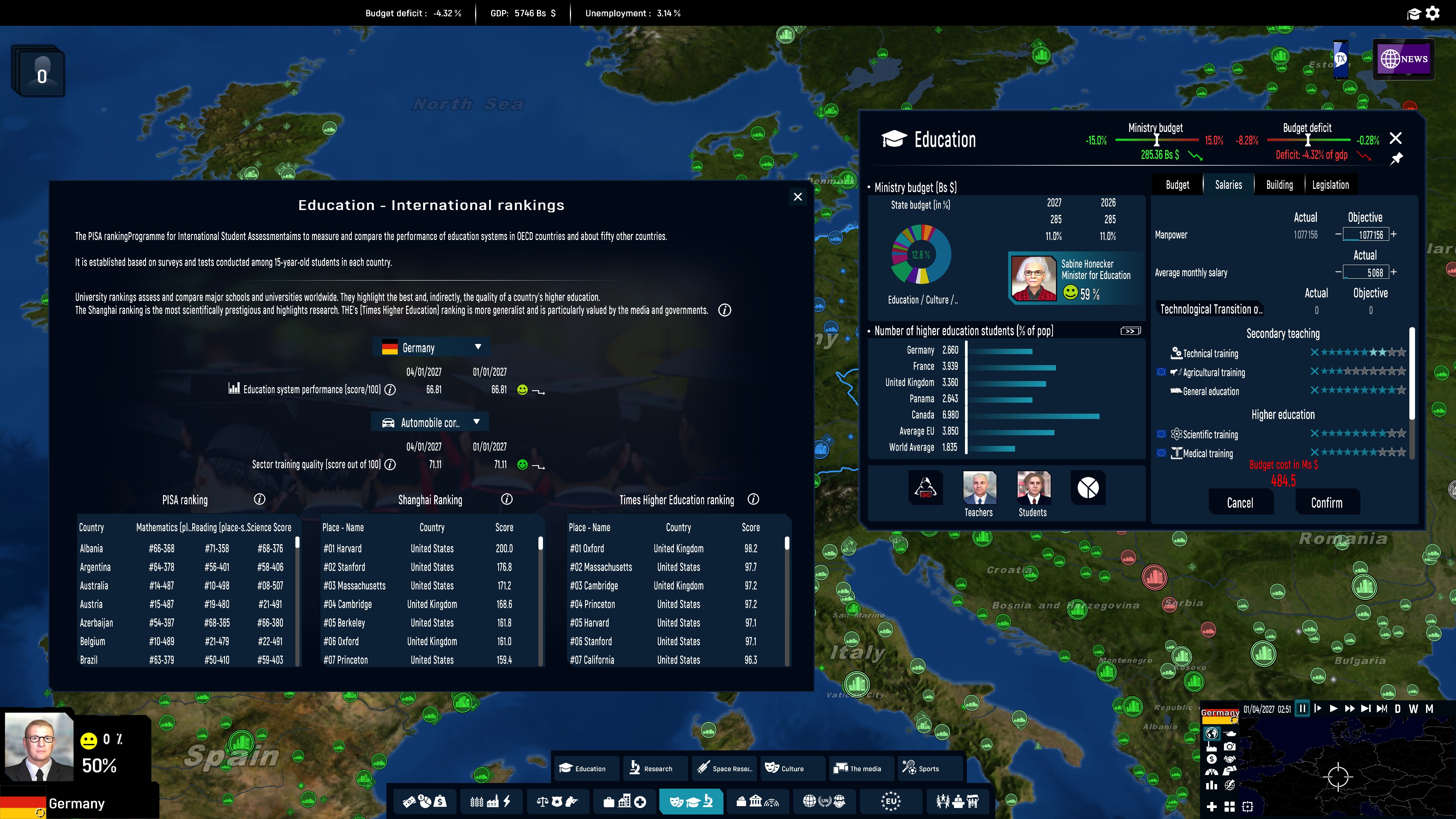
The 2027 Edition includes the main international rankings on education quality. It features PISA, which assesses countries based on the skills of fifteen-year-old students in mathematics, reading, and science; and the major global university rankings (Shanghai, Times Higher Education). These rankings evolve according to the education policies implemented by the state and help attract foreign students and talent, and indirectly foreign companies.
The “Top of the Class” scenario challenges the player–head of state to lead their country to first place in one of the PISA subjects. - New elections
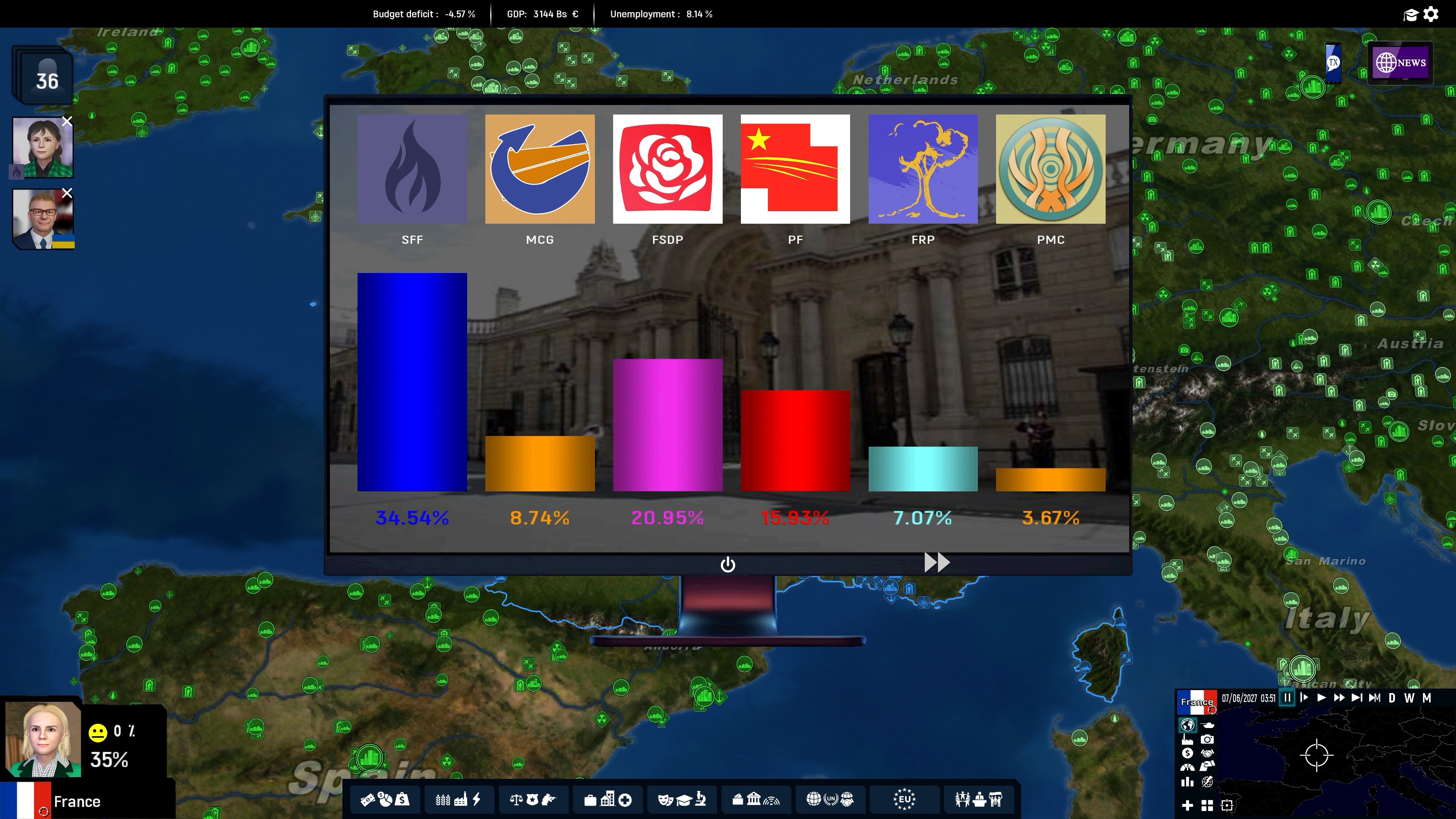
New contextual scenarios are added for the French presidential elections and the Italian parliamentary elections, which will take place in 2027, with all participating political parties and their candidates. The electoral calculations take into account real polls that are updated regularly. - New military units and technologies for modern warfare
-Drone jammer: creates a jamming zone capable of neutralizing enemy drones, helping secure an area against drone threats.
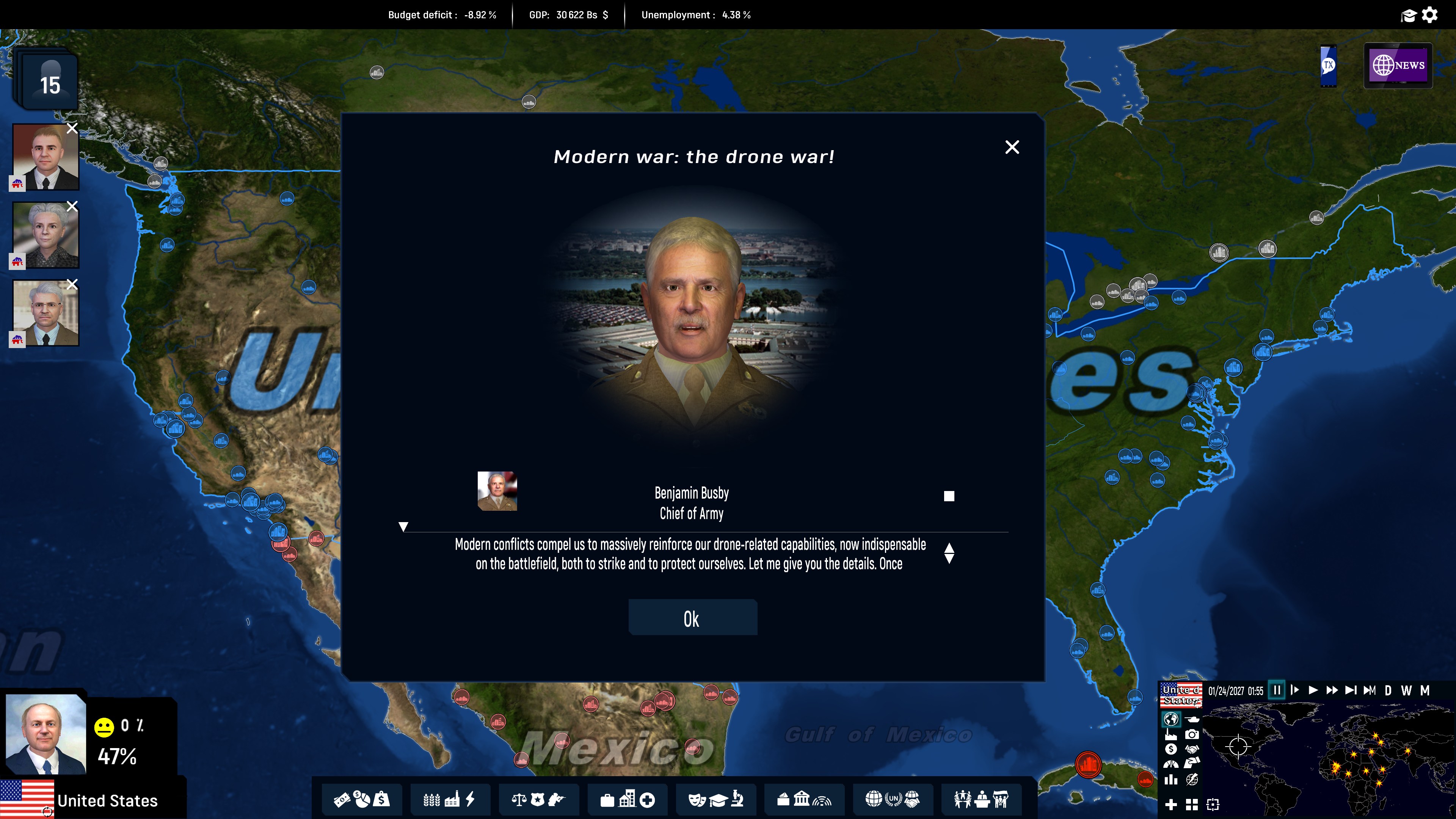
-Drone swarm: a group of small drones capable of reconnaissance, one-way attack missions, automatic interception of enemy drones, and even forming a protective dome around an area.
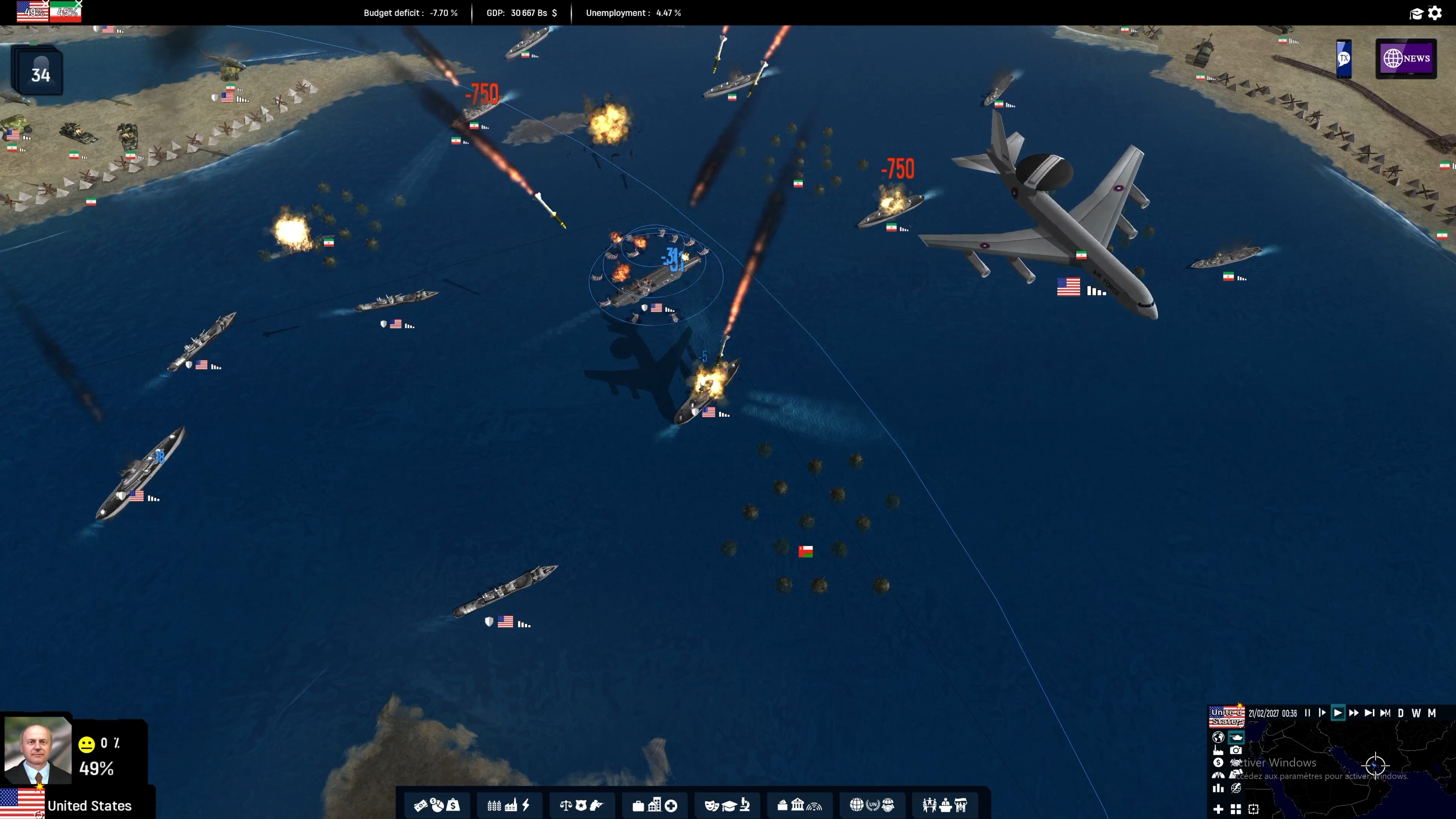
-Sea mines: laid and recovered by cruisers, they damage and slow ships that pass through them. They are highly effective for protecting a strait, coastline, or port.
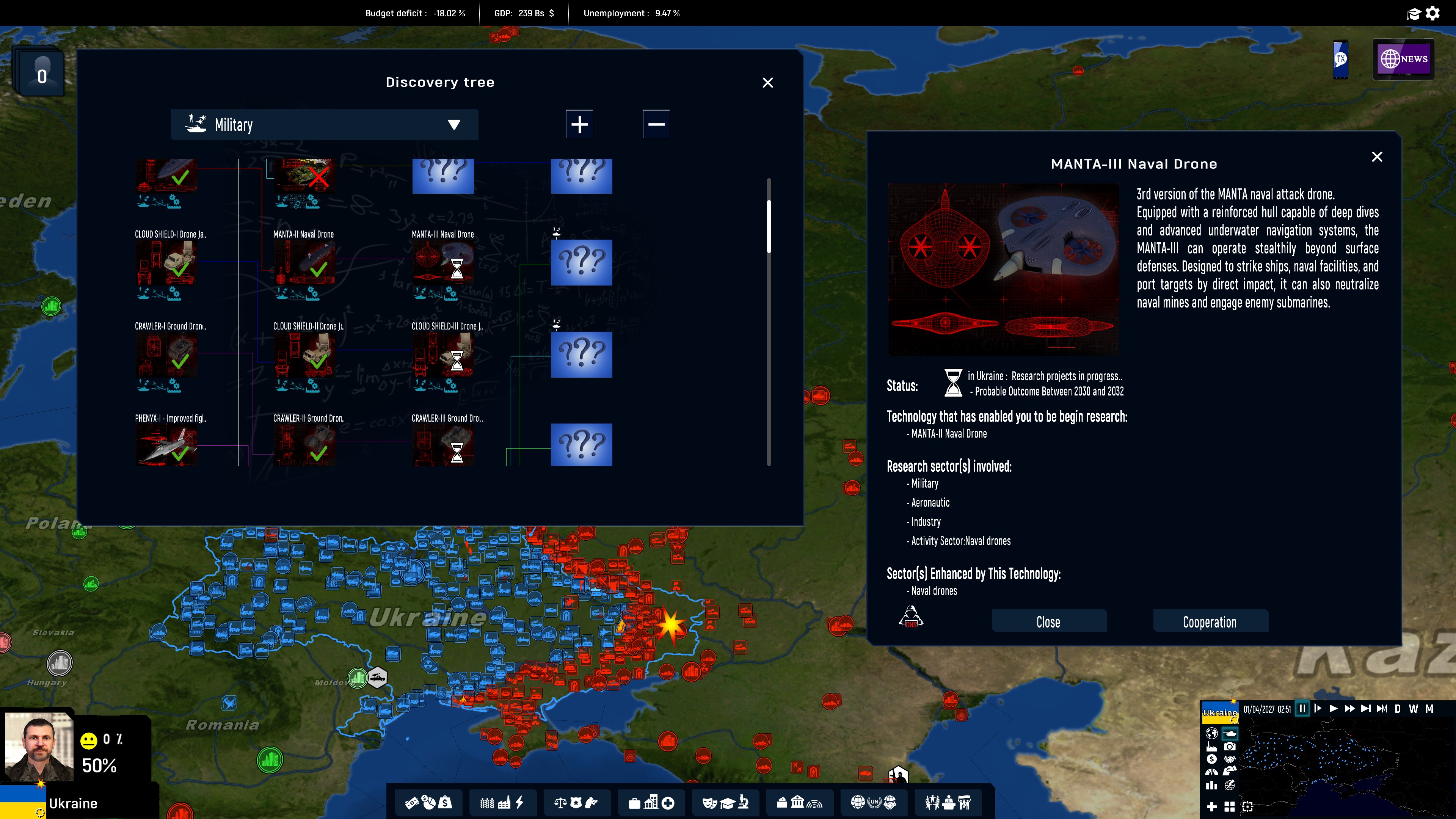
-Naval drones: surface or underwater drones designed primarily to carry out suicide attacks against ships, ports, naval mines, and even submarines for the most advanced versions.
-Unmanned ground vehicles (UGVs): autonomous combat vehicles designed to attack ground units, fortified positions, or military bases, and to take part in the capture of cities.
-AWACS: an airborne early-warning and command aircraft capable of patrolling an area and revealing hidden units. It also improves the defensive capabilities of allied ground and air units within its operational range.
PERFORMANCE AND GRAPHICS IMPROVEMENTS
- More than 50% reduction in game save times and disk space usage.
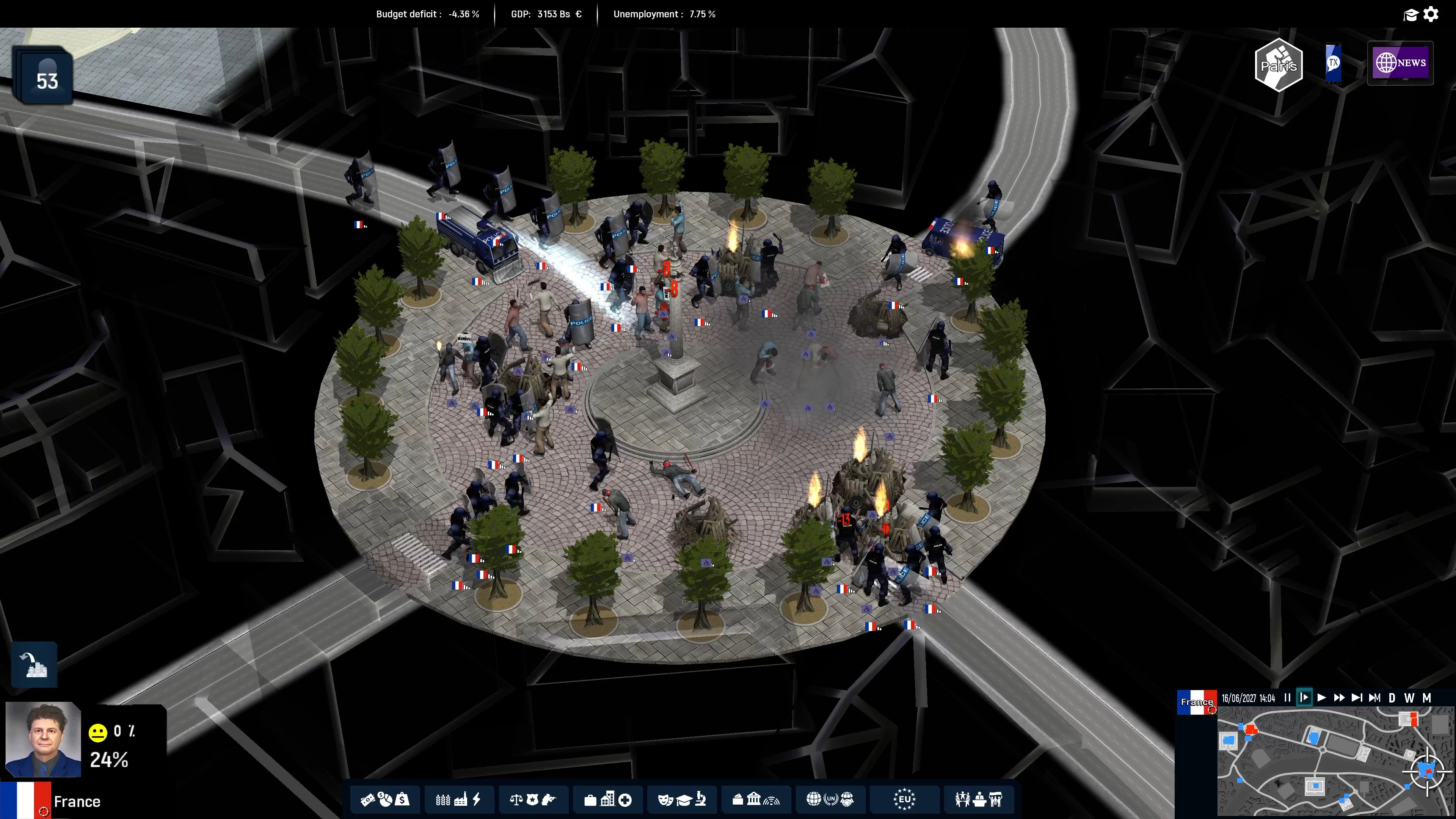
- Frame rate enhancement option for powerful graphics cards, providing smoother gameplay, particularly during wars or when fast-forwarding time.
- New 3D face and outfit generator for characters, featuring high-poly modeling.
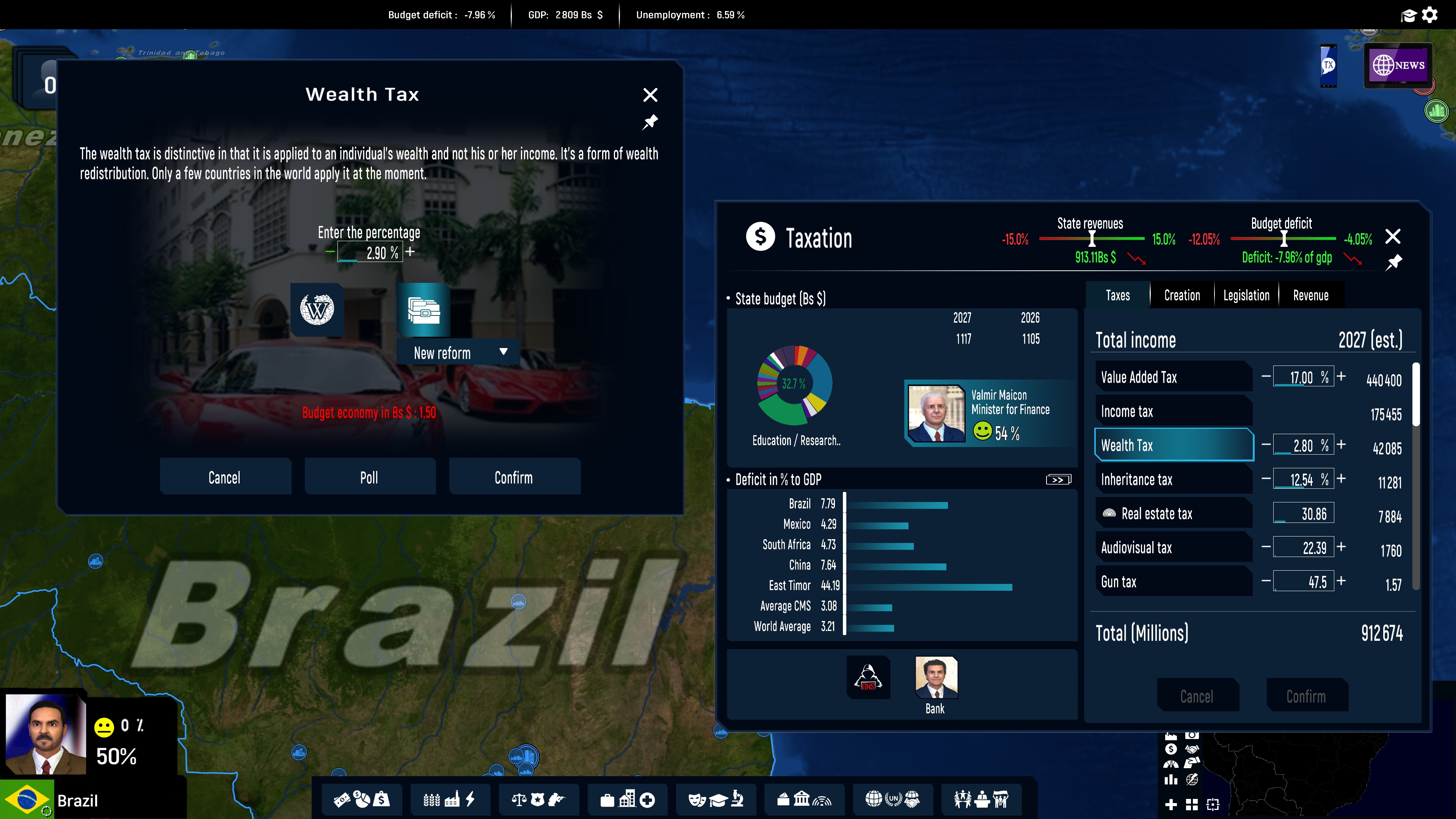
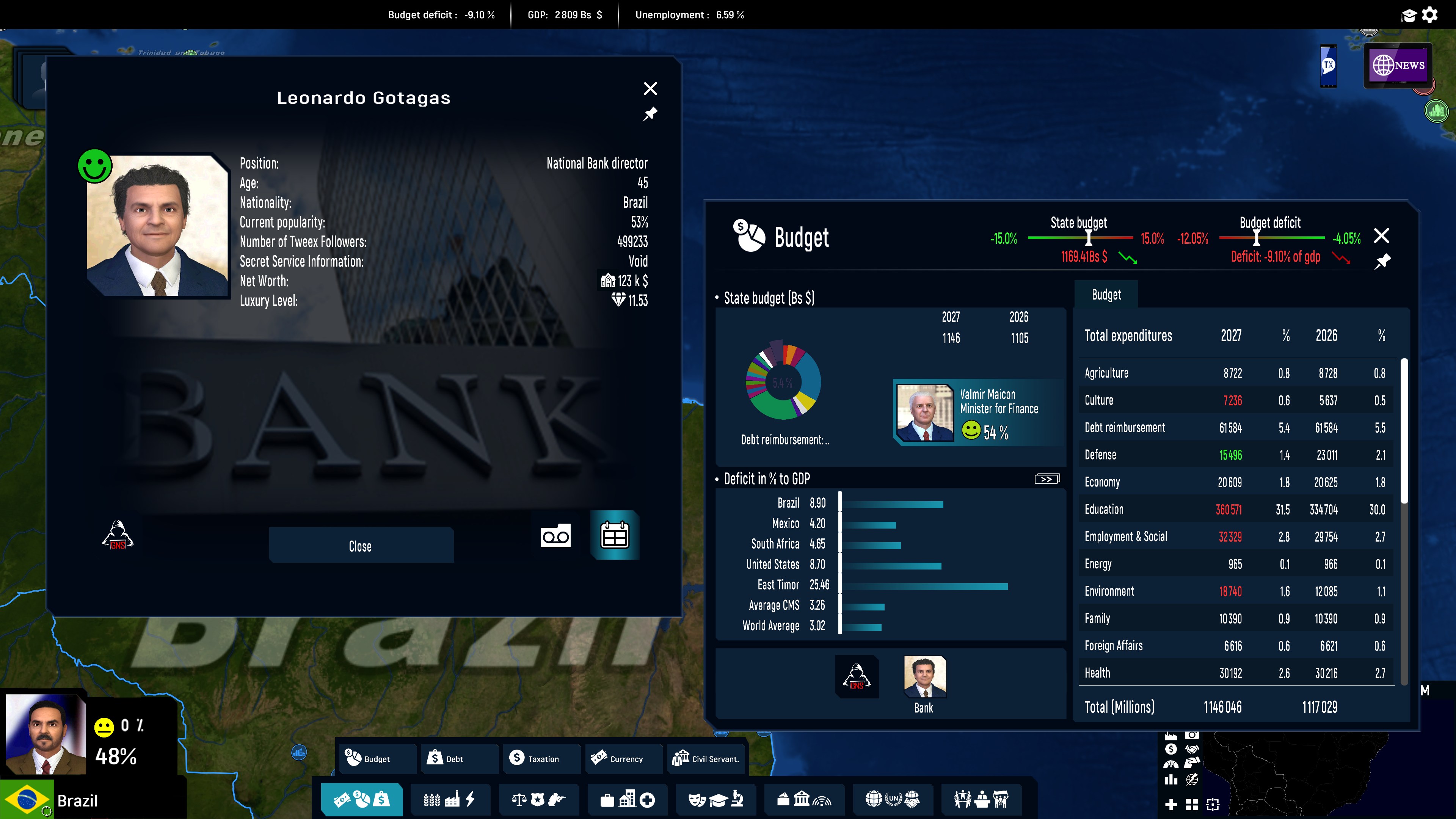
- Numerous new tooltips added to the interface, particularly for the status of closed economic sectors.
DATA UPDATES AS OF JANUARY 1, 2027
- Updated budgetary, economic, social, environmental, political, and geopolitical data (new heads of state and their governments, updated parliamentary compositions, diplomatic relations between countries, etc.).
- Detailed military units for every country in the world, mapping of ongoing conflicts, and addition of territorial waters. Updated terrorist and mafia organizations.
- New achievements.
- Data will be updated regularly through January 1, 2027, particularly to reflect election results.
Minimum configuration
- PC Windows 11 / 10
- 2.4 GHz Quad-Core Processor
- 16 Gb RAM
- 2 Gb VRAM Graphic card
- 16 Gb Hard Drive Space
Recommended configuration :
- PC Windows 11 / 10
- 3 GHz Octa-Core Processor
- 16 Gb RAM
- 4 Gb VRAM Graphic card
- 16 Gb Hard Drive Space
